ENERGY | WIRELESS | NANOTECH | MEMS | OPTICS | QUANTUM | 3D | CHIPS | ALGORITHMS

Tuesday, August 30, 2011

#3D: "All-in-One Solution Offers Complete Stereoscopic Production"

By including a 3D Web camera along with a stereoscopic display, LG has created the world's first all-in-one 3D laptop for creating, viewing and sharing stereoscopic imagery on its smartphones, TVs and glasses-free monitors.


LG's new all-in-one 3D laptop houses the first complete stereoscopic production studio for making, showing and posting 3D social media online for viewing on its smartphones, TVs and glasses-free monitors.

Further Reading

Monday, August 29, 2011

#WIRELESS: "Social Net Saves Fuel With Smartphone"

Crowd-sourcing the state of traffic-lights from dash-mounted smartphones enables smart social networkers to keep cars rolling through green lights, thus cutting fuel consumption by up to 20 percent.


Smarter social networking apps could actually save you money on fuel, according to the Massachusetts Institute of Technology and Princeton University, which recently demonstrated its SignalGuru app. The app watches for red lights and then alerts friends in cars behind the driver to adjust their speed to avoid it.

Further Reading

Friday, August 26, 2011

#SENSORS: "Tattoo-Like Sensors Monitor Brain and Muscles"

Wearable electronic devices can be deposited on the skin like a temporary tattoo.


Electronics have been successfully transferred from a dissolvable carrier to the skin, enabling tattoo-like sensors to monitor brain waves and muscle actions for everything from remote medical diagnosis to immersive gaming to spy-inspired covert surveillance.
Further Reading

Thursday, August 25, 2011

#SECURITY: "Five Steps to Securing Internet-Enabled Devices"

So far the most serious security breaches have been from PCs, but embedded system designers are working to prevent Internet-enabled consumer devices from being used as backdoors for future intrusions.


Wind River, makers of a popular Real-Time Operating System (RTOS) called VxWorks for Internet-enabled devices, claims that there will be 50 billion connected devices in use by 2020, any one of which could become the Internet's weakest link.
Further Reading
Wednesday, August 24, 2011

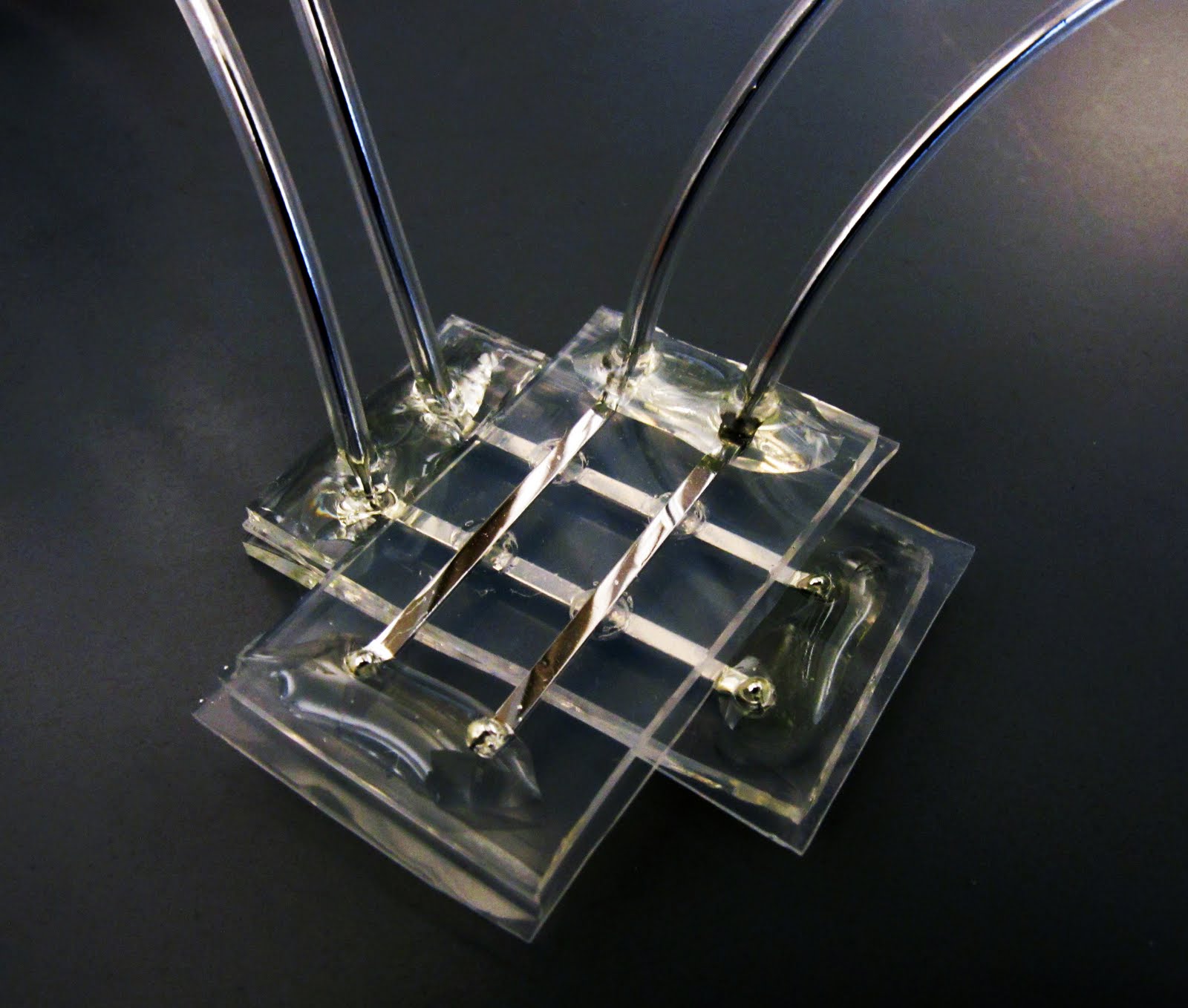
#QUANTUM: Tunneling Enables 3D Touch

Spiked nanoparticles ease quantum tunneling to allow the third-dimension to be sensed by touch-screen users.


Soon, fingers will be able to sense the third dimension by virtue of a supersensitive thin film that harnesses quantum tunneling to sense force. This will allow novel gaming-, artistic- and control-gestures, such as searches that dig deeper into a file structure by pressing harder.
Further Reading

Tuesday, August 23, 2011

#MARKETS: "Analysis Finds Business Disasters Result From Mimicry"


Innovation drives markets, but innovation without oversight can result in isomorphism, when one company's breakthrough money-maker turns out to be the downfall of whole industries, according to a leading business analyst.
Isomorphism in business is the tendency of proven strategies to spread over time, leading industries into similar practices that have been successful for others. Unfortunately, without oversight, a practice that is good for one company can be bad for an industry, in the worst case leading to "terminal isomorphism" similar to what struck the mortgage industry a few years ago.
Further Reading

Monday, August 22, 2011

#ALGORITHMS: "Evolution Has Ossified the Internet"


The Internet is evolving, according researchers at the Georgia Institute of Technology, but unfortunately extinction has resulted in a rigid structure where all information is being forced through a small set of mid-layer protocols that reduce flexibility and decrease security. To remedy, Georgia Tech recommends restructuring the mid-layers into a set of nonoverlapping protocols that do not compete with one another and thus will not become extinct as they evolve.
Further Reading

Friday, August 19, 2011

#SPACE: "Kepler technology spots 'exoplanets'"


In a matter of months after its launch two years ago, the Kepler spacecraft had made more planet sightings than in the entire history of astronomy—1,235 and counting. So far, only 17 have been confirmed, but scientists at the National Aeronautics and Space Administration (NASA) are confident that 80 percent will eventually be verified.
Further Reading

Thursday, August 18, 2011

#CHIPS: "IBM demos cognitive computer chips"


By replicating the functions of neurons, synapses, dendrites and axons in the brain using special-purpose silicon circuitry, IBM claims to have developed the first custom cognitive computing cores that bring together digital spiking neurons with ultra-dense, on-chip, crossbar synapses and event-driven communication.
Further Reading

Wednesday, August 17, 2011

#SECURITY: "China Implicated as Intruder by McAfee"

While never mentioning China by name, a recent McAfee report implicates China as the being behind a rash of malware intrusions into government and industry computers in search of state secrets, industrial designs and intellectual property.


McAfee, the Internet security provider, recently released a study that implicates China as being the state sponsor behind a rash of malware intrusions into government, industry and human-rights organizations computers, resulting in petabytes of state secrets, industrial designs and other intellectual property being stolen.
Further Reading

Tuesday, August 16, 2011

#WIRELESS: "Apple Propelling Mobile, Killing Navigation/MP3/Cameras"

Led by Apple's iPhone and iPad, smartphones and touch-screen tablets are propelling mobile broadband, but cannibalizing single-function devices for navigation, playing music and taking photographs.


Internet appliance shipments (green) are expected to surpass PC sales (blue) by 2013.
More and more users are moving to smartphones and touch-screen tablets—led by Apple's iPhone and iPad—as their main mobile broadband device, but are then using them to also perform navigation, music-playing and picture-taking tasks, thereby causing those markets to fall into decline.
Further Reading

#ALGORITHMS: "Virtual Rat to Cure Human Diseases"

The National Institutes of Health is investing $13 million in a Virtual Rat Project--not to save rats, but to develop analytics that cure human diseases.


Daniel Beard at the Medical College of Wisconsin (Milwaukee) is leading the virtual rat project.
Due to their similar physiology, lab rats have already helped find cures for cardiovascular diseases in humans. But housing, feeding and breeding them is costly. Now the National Institutes of Health is aiming to simplify procedures by creating virtual rats that behave just like the real thing. The five-year $13 million NIH-funded effort aims to develop models of interventions that can be perfected in rats. The models will then be used to mitigate human disease--from high blood pressure to heart failure.


Further Reading

Monday, August 15, 2011

#MARKETS: "Era of the PC Waning"


Personal computers were once considered a bottomless market, but the rise of tablets, smart TVs and other Internet-connected devices has finally established an anchor-point to vault over the PC. First the Internet connected all the world's PCs, and now its dominance is sweeping those antiques away as new consumer-oriented devices offer more convenient access to cloud-based services. Although this trend has been predicted before, it was not until the stunning success of Apple's iPad, that the cannibalization started in earnest, prompting IHS iSuppli to predict that Internet-connected consumer devices will surpass PCs in unit sales by 2013.

Further Reading

Thursday, August 11, 2011

#ALGORITHMS: "Synthetic Biology Redefining Life"


Genetic engineering got an uptick recently when biologists began creating synthetic organisms that will henceforth compete with humans for natural resources, prompting a Presidential Commission to advise "prudent vigilance." Last year, J. Craig Venter, Hamilton Smith and Clyde Hutchison created the first synthetic bacterial cell capable of self-replication, and the race was on between nature-made and man-made organisms. President Obama immediately formed a commission to study the impact of synthetic biology and to make recommendations. The Presidential Commission for the Study of Bioethical Issues makes the recommendation of "prudent vigilance" according to Amy Gutmann, chairman of a report entitled The Ethics of Synthetic Biology: Guiding Principles for Emerging Technologies
Further Reading

#CHIPS: "New architecture promises better battery"


A change in architecture is promising to close the gap between semiconductor technology and battery technology, which has traditionally lagged behind semiconductors due to its dependence on unchangeable chemical reactions. Instead of storing charge in a main battery—then doling it out to individual devices on demand—a new breed of hybrid capacitor/battery is storing just enough energy for an adjacent device's exclusive use. Ioxus Inc. (Oneonta, N.Y.) says it is solving the "battery problem" by defining a new distributed-energy architecture.
Further Reading

Wednesday, August 10, 2011

#CLOUD: "Hundreds of U.S. Data Centers Closing"


To save money, the U.S. government will shut down hundreds of data centers across the country and consolidate their services into its remaining data centers. The White House Office of Management and Budget recently announced that it would be shutting down 373 U.S. government data centers by 2012. Over the last two years, the number of U.S. data centers has quadrupled, and yet they are running at only about 27 percent utilization, according to the Office of Management and Budget. The maintenance costs of these data centers, including backup power supplies, air conditioning, fire-suppression and special security devices, has been astronomical, causing them to consume 200 times more power than the typical office space. By more fully utilizing the remaining data centers, the White House hopes to maintain current service levels while drastically cutting costs.
Further Reading

Tuesday, August 09, 2011

#ALGORITHMS: "IntraLinks SaaS Community Roadmap Unveiled"


Premiere business-to-business deal- and process-management SaaS maker IntraLinks reveals its roadmap for a transformation into a real-time collaboration network. Already an industry leader in secure, cloud-based SaaS (software as a service) tools that more than 1 million business users are accessing to communicate, share documents and manage critical business processes, IntraLinks recently revealed its roadmap for transforming into a real-time collaborative network, complete with community-building toolsets.
Further Reading

Monday, August 08, 2011

#MATERIALS: "Rare Earths Getting Rarer"

Intematix has solved the problem with rare earth scarcity by moving its production to China, for now, and developing alternatives to rare earths in its manufacturing plant in the U.S.


The irony about rare earths is that they are not that rare, its just that the only operating mines, right now, at in China. Eventually, the U.S., Canada, Australia and many other sites in Asia and Europe will open but for the next five year price gouging and hoarding are likely to run rampant...

Further Reading

#ALGORITHMS: "XSEDE Cyber-Science to Exceed Teragrid"


The Extreme Science and Engineering Discovery Environment (XSEDE) exceeds its predecessor--the Teragrid project--by linking the most advanced U.S. supercomputers into a cyber-infrastructure provisioned with simplified user-access software enabling researchers to address more diverse projects extraordinaire.

Further Reading

Friday, August 05, 2011

#CHIPS: "Authentication Chips Combat Rampant Counterfeiting"


Counterfeiting has spread from credit cards to microchips to circuit boards and entire networking appliances, prompting semiconductor makers worldwide to pioneer a new billion dollar market for smart authentication microchips.

Further Reading

Thursday, August 04, 2011

#MARKETS: "Smart Navigation Beats Out Social Media"

As more and more automobile owners conduct business and pleasure from their "connected car," navigation apps and Internet access continue to outpace social media and even streaming radio in popularity. For the ultimate mobile platform--our automobiles--smarter drivers continue to desire "serious" navigation and Internet services over social networking and even streaming radio.
Further Reading

Tuesday, August 02, 2011

#CHIPS: "Freescale processors gain on-chip e-reader"


Earlier this year, Freescale Semiconductor Inc. announced the first line of processors designed to power sub-$99 e-readers. Now it has extended that line downward with integrated E-Ink driver circuitry for low-end devices from medical and home/office automation to watches whose face is an electronic paper display (EPD).
Further Reading

#ALGORITHMS: "Top Trader Bot Beats All Humans"


Human traders don't have a chance against bots which have been competing among themselves for a decade, resulting in a super-bot whose adaptive aggression annihilates all animates. A decade has passed since IBM's seminal demonstration that software bots could beat humans at securities and commodities trading. Since then the bots have been competing among themselves until now, on the 10-year anniversary of bot's supremacy, an architecture called AA (adaptive-aggressive) has emerged as king-of-the-hill.
Further Reading

Monday, August 01, 2011

#MATERIALS: "Wet Electronics Open Door to New Possibilities"


Gadgets, gizmos and wireless wonders must be fastidiously protected from moisture today, but researchers using circuitry with the consistency of Jell-O claim that the smarter electronics of the future will be all wet. Twice I ran my old Sony-Ericsson cell phone through the washing machine and it miraculously survived, but that is only a testimonial to device's excellent waterproofing technologies. That all may change soon, when ultra-secure moisture-friendly prototypes recently shown by North Carolina State University (NCSU) are commercialized.
Further Reading

#NANOTECH: "Nanocircuits that adhere to any substrate"


Researchers at Stanford University recently demonstrated a novel wafer-scale lift-off process for fabricating nanowire-based circuits on reusable silicon wafers, then transferring them to any substrate in any shape. The research team, led by professor Xiaolin Zheng, claims the flexible circuitry can be used to create anything from paper-thin displays and solar cells to biomedical sensors that attach directly to the tissue being monitored.
Further Reading