ENERGY | WIRELESS | NANOTECH | MEMS | OPTICS | QUANTUM | 3D | CHIPS | ALGORITHMS

Tuesday, August 02, 2011

#ALGORITHMS: "Top Trader Bot Beats All Humans"


Human traders don't have a chance against bots which have been competing among themselves for a decade, resulting in a super-bot whose adaptive aggression annihilates all animates. A decade has passed since IBM's seminal demonstration that software bots could beat humans at securities and commodities trading. Since then the bots have been competing among themselves until now, on the 10-year anniversary of bot's supremacy, an architecture called AA (adaptive-aggressive) has emerged as king-of-the-hill.

The International Joint Conference on Artificial Intelligence (IJCAI), held last month in Barcelona, marked a decade since its 2001 meeting where software robots (bots) proved their supremacy over humans at stock-market trading. Technically called a continuous double auction--since both buyers and sellers set prices on their offers--CDA today dominates the trading activity on nearly all commodity and stock exchanges. Most institutional investors use bots that are variations on the well-known CDA strategies which were outlined a decade ago in an IBM paper at IJCAI 2001 entitled: Agent-Human Interactions in the Continuous Double Auction.

In that paper, software bots were shown to consistently outperform human traders on real-time CDA markets, in particular by using two trading-agent strategies called ZIP (zero-intelligence plus) and GD (after the economists Steven Gjerstad and John Dickhaut). In subsequent work, the same research group at Thomas J. Watson Research Center reported an improved strategy they called GDX, which outperformed both ZIP and GD when bots were pitted against other bots (as is the case today on most modern stock and commodities exchanges).

The performance of IBM's GDX continues to be used as a figure-of-merit for commercial bidding strategies, but according to a new paper presented this year at IJCAI 2011, a newer strategy called Adaptive Aggressive (AA) outperforms ZIP, GD and GDX in bot-versus-bot trading. The new paper entitled: Human-Agent Auction Interactions: Adaptive-Aggressive Agents Dominate was presented last month at the conference by professor Dave Cliff and doctoral candidate Marco De Luca, both of the University of Bristol (England).

The AA algorithm differs for the other algorithms in that it aggressively trades off profit for the ability to make a transaction, it then adapts its aggressiveness after each completed buy or sell. By mimicking the method used in IBM's original paper to judge the bots, Cliff and De Luca claim to show that AA outperforms all the other strategies in both bot-to-bot and human-versus-bot trading.

Further Reading

Monday, August 01, 2011

#MATERIALS: "Wet Electronics Open Door to New Possibilities"


Gadgets, gizmos and wireless wonders must be fastidiously protected from moisture today, but researchers using circuitry with the consistency of Jell-O claim that the smarter electronics of the future will be all wet. Twice I ran my old Sony-Ericsson cell phone through the washing machine and it miraculously survived, but that is only a testimonial to device's excellent waterproofing technologies. That all may change soon, when ultra-secure moisture-friendly prototypes recently shown by North Carolina State University (NCSU) are commercialized.

Today, electronic devices of all types must be protected from not only submersion in water, but even from humidity in the air. Medical implants, for instance, must be hermetically sealed to secure them from shorting out. By harnessing the synergy between water-compatible hydrogels and liquid metals, NCSU researchers herald a new era of smarter moisture-compatible electronic devices.
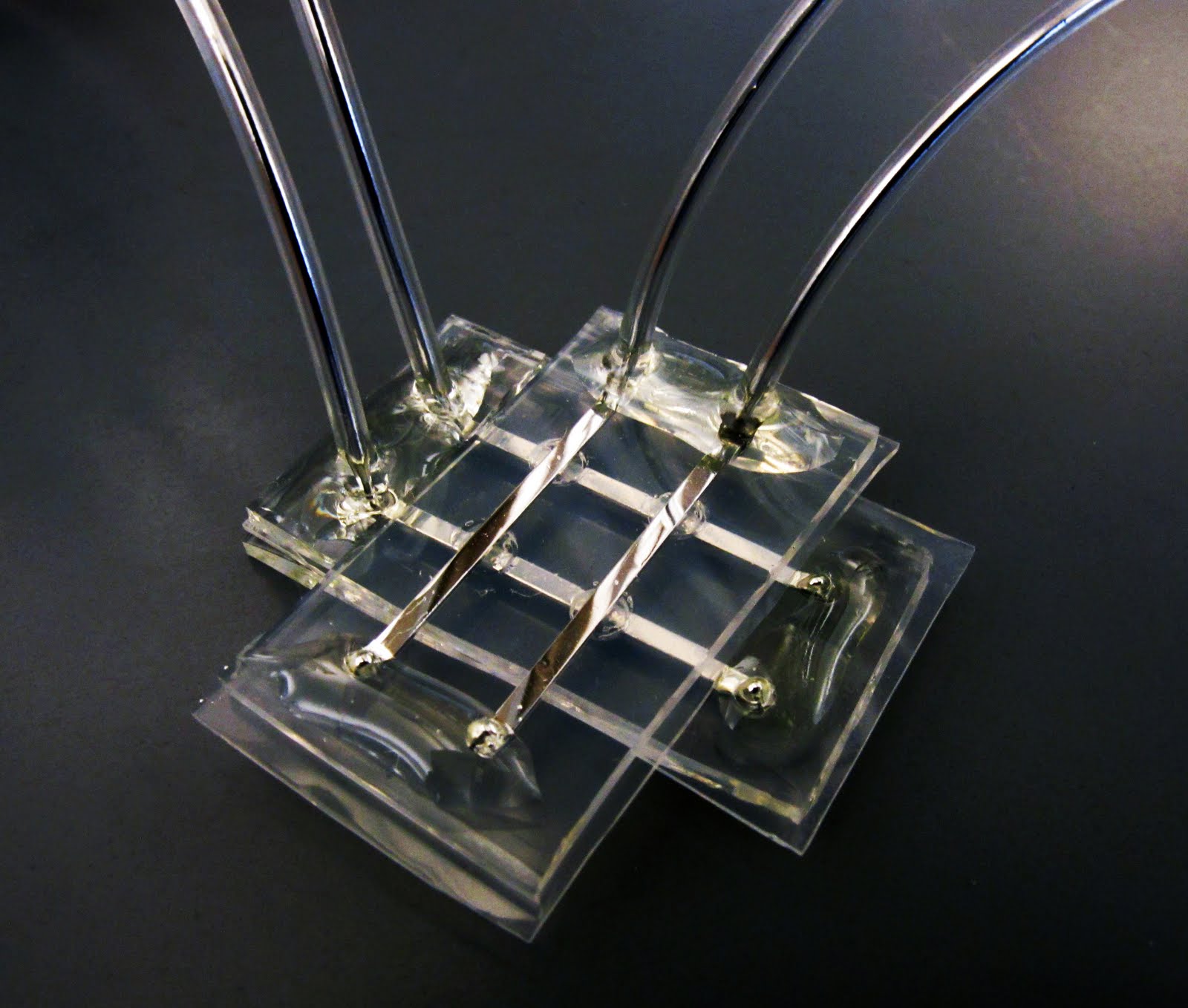
A 2-by-2 array of crossbar switches where memory-resistors at each crossing operate like synapses in the brain. (Source: NCSU)

As you might imagine, materials that can happily be submerged without dissolving or shorting out their circuitry are few and far between. And those that can—such as plastics—have inferior electrical characteristics, making them too slow reacting for medical implants and other mission-critical electronics that must work rain or shine. However, by combining liquid metals with polyelectrolyte hydrogels, which have the consistency of Jell-O, a new class of fast submersible gadgets is on the horizon.

The key to this invention of NCSU professor Michael Dickey, however, is not the water compatibility of the materials themselves, but rather the ability of the metal—an eutectic alloy of gallium and indium—to form a nonconductive oxide skin when current flows through it. The switches can be programmed to act like synapses in the brain. In effect, these crossbar switches remember their "experiences"—an effect called a memory-resistor, or memristor, by their inventor, University of California at Berkeley professor Leon Chua (this technology is currently being commercialized by HP Labs and Hynix).

Consequently, the new liquid-metal/hydrogel combination can be used to create brainlike circuitry that learns from its environment. The first task of these new water-compatible circuits, however, will be much less ambitious, since for one thing they are still being built on the millimeter scale rather than the micron- and nano-scale of circuitry in the brain. However, simple circuitry can be realized with the new approach to create biological sensors that can be directly implanted for medical monitoring.

NCSU doctoral candidates Hyung-Jun Koo and Ju-Hee So also contributed to the work, which was funded by the National Science Foundation and the U.S. Department of Energy.

Further Reading

#NANOTECH: "Nanocircuits that adhere to any substrate"


Researchers at Stanford University recently demonstrated a novel wafer-scale lift-off process for fabricating nanowire-based circuits on reusable silicon wafers, then transferring them to any substrate in any shape. The research team, led by professor Xiaolin Zheng, claims the flexible circuitry can be used to create anything from paper-thin displays and solar cells to biomedical sensors that attach directly to the tissue being monitored.
Further Reading

Friday, July 29, 2011

#ALGORITHMS: "Gig.U to Extend LAN Speed Among Schools"


Universities nationwide are banding together to extend the gigabit per second speeds typical of modern local-area networks to long-distance connections among signatory educational institutions.

Many modern PCs offer gigabit per second local-area network speeds to those willing to upgrade their switches and cables from the 10/100 megabits per second, which most people get by with on their LANs. Gig.U, on the other hand, plans to promote gigabit per second speeds over long-distance connections between signatory universities.

Gigabit per second speeds perform between 10 and 100 times faster than the typical 100- and 10-megabit per second local area network, respectively. But the difference is only a matter of seconds for the small files typically transferred by most home users. For real-time gaming, however, almost no time-lag will be perceived when gamers run on a LAN. However, extending even 100M bps LAN speeds to a broadband connection among remote gamers can cost $100 to $200 per month from Internet Service Providers.

Universities, on the other hand, routinely transfer large files for scientific research, making gigabit per second connections a real time-saver. And like the network gamer, simulations and visualizations of scientific data can be performed remotely if a user's terminal has access to gigabit per second connections.

Universities nationwide have signed onto Gig.U by soliciting ideas for how to extend gigabit per second local-area network speeds over long-distance connections.
Many technical universities have already extended such high-speed LAN connections among themselves, such as MIT's 10G bps Regional Optical Network that operates on the eastern seaboard. Stanford University has a Google-sponsored pilot program that extends gigabit per second LAN speeds to nearby residents there, and Case Western--a Gig.U signatory--has a similar pilot program in Cleveland.

The other 28 universities backing Gig.U, however, want to level the playing field by providing such high-speed connections among even remotely located universities, from Alaska to Hawaii. The 29 universities include: Arizona State, Case Western, Colorado State, Duke, George Mason, Howard, Indiana, Michigan State, North Carolina State, Penn State, Virginia Tech, Wake Forest, West Virginia and the Universities of Alaska, Chicago, Florida, Hawaii, Illinois, Kentucky, Louisville, Maryland, Michigan, Missouri, Montana, New Mexico, North Carolina, South Florida, Virginia and Washington.

The Gig.U effort will likely take several years to develop, since the current stage of the program merely has universities circulating a request-for-information (RFI) from interested parties about how to provide gigabit-per-second to remote universities in an economical manner. The idea is to solicit partnerships with industry and other remote users who also need high-speed connections, such as health-care institutions, in order to come up with creative methods of financing long-distance high-speed networks. If workable solutions are forthcoming, the next step will be request-for-proposals (RFPs) about how to actually implement the solutions proposed by the RFIs.

Initiated by The Aspen Institute's Communications and Society Program, the effort will be directed by Blair Levin, former Executive Director of the National Broadband Plan and a Fellow at the Aspen Institute.

Further Reading

Thursday, July 28, 2011

#3D: "Smarter 3D Employs Eye Tracking"


LG claims to have solved the problems with glasses-free 3D displays with a smarter eye-tracking technology that adapts to the viewing angle of the user. Available this fall in a 20-inch monitor, the smarter 3D solution eliminates the need for glasses and is compatible with normal 2D imagery.

Glasses-free 3D displays, called auto-stereoscopic displays, have in the past depended on lenticular lenses that fit over displays to divert separate images to the right and left eyes. Unfortunately, lenticular lenses scramble regular 2D images. Parallax barriers are an alternative to lenticular lenses, but they do not provide a wide variety of viewing angles. LG has solved this last remaining problem with smarter eye-tracking technology that adapts the parallax barrier as the viewer's head moves.

Parallax barriers work similarly to lenticular lenses in that they divide an image into alternating stripes for the left- and right-eye. However, instead of using a lens to bend the alternating stripes to the correct eye, a parallax barrier uses a second layer of alternating clear and black lines to block the left-eye stripes from reaching the right eye, and vice versa. The brain fills in the gaps between stripes, resulting in completely separate images reaching the correct eyes without the need for lenticular lenses or 3D glasses.

Unfortunately, the tiny parallax-barrier stripes must be precisely located in order to correctly block the right-eye stripes form the left eye and vice versa. Thus in the past, parallax-barrier displays have only been successful with smaller screens like cell phones where users keep their heads centered on the screen anyway. However, larger displays did not work well with parallax barriers, because users are much more likely to move their heads out of the correct central location.
LG's solution was to add an eye-tracking camera that adjusts the parallax barrier so that it reliably diverts the left- and right-eye stripes to the correct eye even for users moving their heads.

The application of LG's smarter glasses-free 3D technology will be in its new 20-inch wide D-2000 display. The only major limitation is that it can only track the location of a single user's eyes. Thus the technology is not appropriate for TVs where multiple users may be watching from different angles. However, for single users, LG's smarter eye-tracking technology solves all the problems associated with auto-stereoscopic 3D displays and is suitable for still images, movies and gaming. The display also has a built-in conversion capability that adds some degree of 3D to 2D movies and games (but not still images).
Further Reading

Wednesday, July 27, 2011

#ALGORITHMS: "Seven Reasons HTML5 Is Killing Flash"


Seven inherent features in HTML5 are eliminating the need for Adobe Flash as well as enabling Websites to add capabilities that rival native applications. The fifth generation of the hypertext markup language--HTML5--is adding capabilities once reserved for plug-ins and native applications. Test your browser's HTML5 compatibility by visiting The HTML5 Test site.

Today, more than 109 million mobile users have HTML5-ready browsers, but by 2016, more than 2.1 billion mobile users will be compatible, according to ABI Research. There remain significant details to work out, which could delay the final specification until as late as 2020. However, long before then, HTML5 features will be available that virtually obsolete Flash, as well as enable normal Website developers to create universal applications that run on any platform.

According to ABI Research senior analyst, Mark Beccue, there will be 25 key HTML5 features available to most users over the next three to five years. Smarter Technology recently asked Beccue to pick the seven top features out of those 25 that will be most important to users. Here is his list:

#1-Video Play: The No. 1 reason to use Flash today is to play video, but HTML5 includes a tag for videos that allows it to play with all the start, stop, pause and other features people already expect from YouTube and other Flash-based sites.

#2-Video Record: This feature is not a common today, but will become increasingly important, according to Beccue, because virtually all new mobile devices with Web access also have video cameras.

#3-Audio Play/Record: Today, you need Flash, Quicktime or Java to play or record audio, but with HTML5 it is just another tag.

#4-Apps: HTML5 allows Web pages to directly access the same routines that make browsers work, enabling them to run free standing just like an ordinary application. (Try this feature out by downloading the Financial Times app.)

#5-Rich 2D Graphics: All types of sophisticated two-dimensional graphics will be built-into HTML5, enabling faster operation and nearly instant loading compared with the slow loading time for sites using rich graphics today.

#6-IM: Instant messaging will be built into HTML5 by virtue of Web sockets--which, once opened between two users, will allow instantaneous communications. (Try this out by running this Websocket demo in two windows.)

#7-Real-Time Streams: Websockets will also allow any Web-page designer to easily add real-time data streams--from stock market prices to surf reports--which today requires complicated programming outside the capabilities of most HTML coders.
Further Reading

Tuesday, July 26, 2011

#ENERGY: "U.S. Renewables Outpace Nuclear Power"


The U.S. Energy Information Administration reports that renewable energy sources in total have surpassed nuclear power, and are likely to widen the gap unless new nuclear plants are built.

U.S production of energy from renewable sources recently passed that from nuclear reactors despite administration efforts to revitalize U.S. nuclear power generation with federal loan guarantees for constructing new nuclear reactors.

In his 2011 State of the Union speech, President Obama said, "We need more production, more efficiency, more incentives. That means building a new generation of safe, clean nuclear power plants in this country."
Obama's attempt to paint nuclear energy green, however, was before the nuclear disaster in Japan, which has prompted nations worldwide to back away from nukes, including Germany which has pledged to concentrate on renewable energy and shut down all its nuclear power plants by 2022.

The Obama Administration, on the other hand, is currently proposing to add $36 billion to the current $18.5 billion in loan guarantees for new nuclear power plant construction in its FY2011 budget, bringing the total to $54 billion—nearly tripling the money currently available for new nuclear reactors.

Renewable energy passed that of nuclear power in March 2011 (in quadrillion BTUs). (Source: Energy Information Administration)
Meanwhile the world continues to reel from the triple meltdown at the Fukushima-daichi nuclear complex in Japan. Efforts there have been plagued by problems and missteps.

In the wake of this continuing fiasco, one bright light shines--namely, that renewable energy sources have already passed nuclear power generation in the U.S. and are on-track to outpace oil too.

The U.S. Energy Information Administration reported that renewable energy sources--which include hydroelectric, solar, wind, geothermal, and bio-mass/fuels--were responsible for 0.805 quadrillion BTUs of energy, or about 17 percent of the total U.S. energy generation, in March 2011. Nuclear, on the other hand, provided 0.687 quadrillion BTUs, or about 14.5 percent, according to EIA estimates.

Comparing the entire first quarter of 2010 to 2011, renewable energy sources rose about 15 percent, according to the EIA, and compared with the first quarter of 2009, renewable energy rose over 25 percent, marking accelerated growth in 2011.
Further Reading

#ALGORITHMS: "Client-Based Virtualization Gains Momentum"


Server-hosted virtualization is the poster-child of cloud computing where thin clients share a single IT-managed image. However, client-hosted virtualization is gaining momentum by claiming to offer IT cost savings, simpler centralized management, plus an enriched user experience comparable to stand-alone PCs.

In the beginning, IT had to spend weeks setting up, provisioning, upgrading and maintaining fleets of PCs on each of their user's desks. Server-hosted virtualization was a major step forward by cutting those times down to days or in some cases just hours, plus the thin-clients were cheaper than putting a PC on every user's desk. Today, however, the cost of PCs has dropped to nearly match that of thin clients, plus the resultant client-hosted virtualization infrastructure cuts IT set-up, provisioning, upgrading and maintenance times down to minutes instead of hours or days.

Client-hosted virtualization for 1,000 users requires only a single server (compared with 20 for server-hosted virtualization), as well as laptop support and quicker recovery, provisioning, patching, setup and upgrades.

Client-hosted VDI (virtual desktop infrastructure) executes all application code on a desktop PC, which to the user appears to be a normal local operating system with all the advantages of high-speed execution for bandwidth-intensive applications like HD (high-definition) video, plus it works with all their local USB peripherals. In the background, however, their OS is really a copy of a centralized image managed by IT for up to 1,000 users from a single server, which can be located on-premises or in the cloud.

Server-hosted VDI, on the other hand, executes code on a server which can only handle about 50 users and must maintain not only the image, but must also house the user's data, requiring 20 to 25 times more IT hardware resources and up to 20 times the IT personnel over client-hosted VDI. In addition, local USB peripherals are difficult to install and using high-bandwidth media like HD video is nearly impossible to support for large numbers of users.

Intel, for one, is championing client-hosted virtualization as the wave of the future. Intel calls this intelligent desktop virtualization and is promising a new breed of multi-core processor to directly support client-hosted VDI. However, IT does not have to wait for these specialized processors to get in on this emerging trend, because many inexpensive desktop PCs today are already configurable for client-hosted virtualization from companies like Virtual Computer, RES Software, Wanova, MokaFive and Scense.

For example, Virtual Computer has been delivering its NxTop desktop-virtualization platform as an alternative to server-hosted VDI for 18 months. Recently, sales have skyrocketed fivefold, prompting Virtual Computer to announce this month a new Global Partner Program to keep up with demand.

"Client-hosting greatly reduces the cost of virtualization; plus, it eliminates the complexity and many of the limitations inherent in server-hosted VDI," said John Glendenning, senior vice president of worldwide sales and business development for Virtual Computer. "And with the new Global Partner Program, we have created a channel for IT that should greatly simplify implementing client-hosted virtualization for businesses of nearly any size."
Further Reading