ENERGY | WIRELESS | NANOTECH | MEMS | OPTICS | QUANTUM | 3D | CHIPS | ALGORITHMS

Wednesday, February 13, 2013

#BOOKS: "'Critical Play: Radical Games' Changing Rules"

"Shoot'em Up" was the motto of designers of the world's most popular games, that is until designers started adding creativity into the mix, starting with games like The Sims. Now artists and designers worldwide are lending their creativity to a new approach to game design--the subject matter of "Critical Play: Radical Games": R. Colin Johnson @NextGenLog


Here is what the publisher says about "Critical Play: Radical Games": For many players, games are entertainment, diversion, relaxation, fantasy. But what if certain games were something more than this, providing not only outlets for entertainment but a means for creative expression, instruments for conceptual thinking, or tools for social change? In Critical Play, artist and game designer Mary Flanagan examines alternative games -- games that challenge the accepted norms embedded within the gaming industry -- and argues that games designed by artists and activists are reshaping everyday game culture.
Further Reading

Tuesday, February 12, 2013

#CHIPS: "Neuromorphic: Ultimate Parallel Processors"

Purdue University is working with semiconductor researchers, including Intel research scientist Charles Augustine of its Circuits Research Lab (Hillsboro, Ore), to develop spin-based neuromorphic microchips as the ultimate parallel processors–consuming as little as 300-times less power than circuits today.


By combining bipolar spin neurons with memristors (phase change memory), input signals can program self-adaptive weights sandwiched between metal interconnects. SOURCE: Purdue

Traditional semiconductor chips use electrical charge to store information, requiring thousands of electrons to be transferred onto a storage device, like a capacitor, until its voltage exceeds a threshold. However, switching from encoding digital ones and zeros with electrical charge to using the spin-state of electrons can drastically cut the energy consumption of electronic circuits.

Spin states are inherent to electrons, which are constantly spinning, imparting a momentum to their electrical charge which can be oriented “up” or “down”. Such spin-polarized electrons can be used to encode digital ones and zeros using much less energy than just piling up charge on a capacitor. Ideally, a single electron could be used to store a digital one as “up” spin and a digital zero as “down” spin, enabling the ultimate downsizing for parallel processors to one-bit-per-electron. And for intrinsically parallel applications, such as emulating the billions of neurons in the human brain, the super low power achieved by spin-polarized digital encodings could enable the ultimate parallel processing applications of the future.
Further Reading

Friday, February 08, 2013

#CHIPS: "Microserver Market to Triple in 2013"

Micro-servers have become the fastest growing segment of the cloud-computing and datacenter market, tripling in size in 2013, according to IHS iSuppli. A half-dozen startups will be hawking ARM-based processors for micro-servers starting in 2014, which will compete with Intel Atom-based micro-servers for about 10 percent of the total server market by 2016: R. Colin Johnson @NextGenLog

Micro-server markets will grow at about a 130 percent compound annual rate until 2016, according to IHS iSuppli.
Further Reading

Thursday, February 07, 2013

#OPTICS: "Light Funnels Enable Reflective Displays"

Micro-electro-mechanical systems (MEMS) are already used for reflective displays, such as the Mirasol from Qualcomm which modulates the depth of nanoscale slits. Now University of Michigan researchers have demonstrated how adjusting both the depth and the width of sub-wavelength grooves enables a widening of the field-of-view--even when viewed in bright sunlight: R. Colin Johnson @NextGenLog

Nanoscale grooves whose depth and width is proportional to the wavelength of filter light illustrate here the full visible spectrum--from violet to blue to green to red to yellow.
Further Reading

#CHIPS: "Fujitsu HPCs Pack Xeon Phi Coprocessor"

Fujitsu is aiming to boost its ranking in high-performance computing (HPC) by adopting the Xeon Phi for its Pimergy line of servers housing up to 920 parallel processing x86 cores per rack, with larger supercomputers configured using its Smart Scale-Out building blocks: R. Colin Johnson @NextGenLog

Fujitsu adopted the Xeon Phi for its next-generation high-performance computing (HPC) platform using its Primergy servers. SOURCE: Fujitsu
Further Reading

Wednesday, February 06, 2013

#WIRELESS: "Smartphones, Tablets in Everybody's Future"

Apple sold almost 48 million iPhones in the fourth quarter of 2012 alone, but ABI Research claims that the total installed base of 45 million Windows Phones and 20 million Blackberry-10s is still enough to interest software app developers in supporting them. The total installed base of smartphones worldwide will be 1.4 billion by the end of 2013 with 57 percent running Android and 21 percent iOS; whereas there will be 268 million tablets total--62 percent using iOS and 28 percent Android. Annual growth for smartphones will be 44 percent and a whopping 125 percent for tablets, all according to ABI Research (Oyster Bay, N.Y.): R. Colin Johnson @NextGenLog

ABI’s Mobile Application Technologies Research Service takes a deep dive into the technologies enabling "transformative" applications.SOURCE: ABI Research
Further Reading

#ENERGY: "Self Powered Sensors Eliminate Battery"

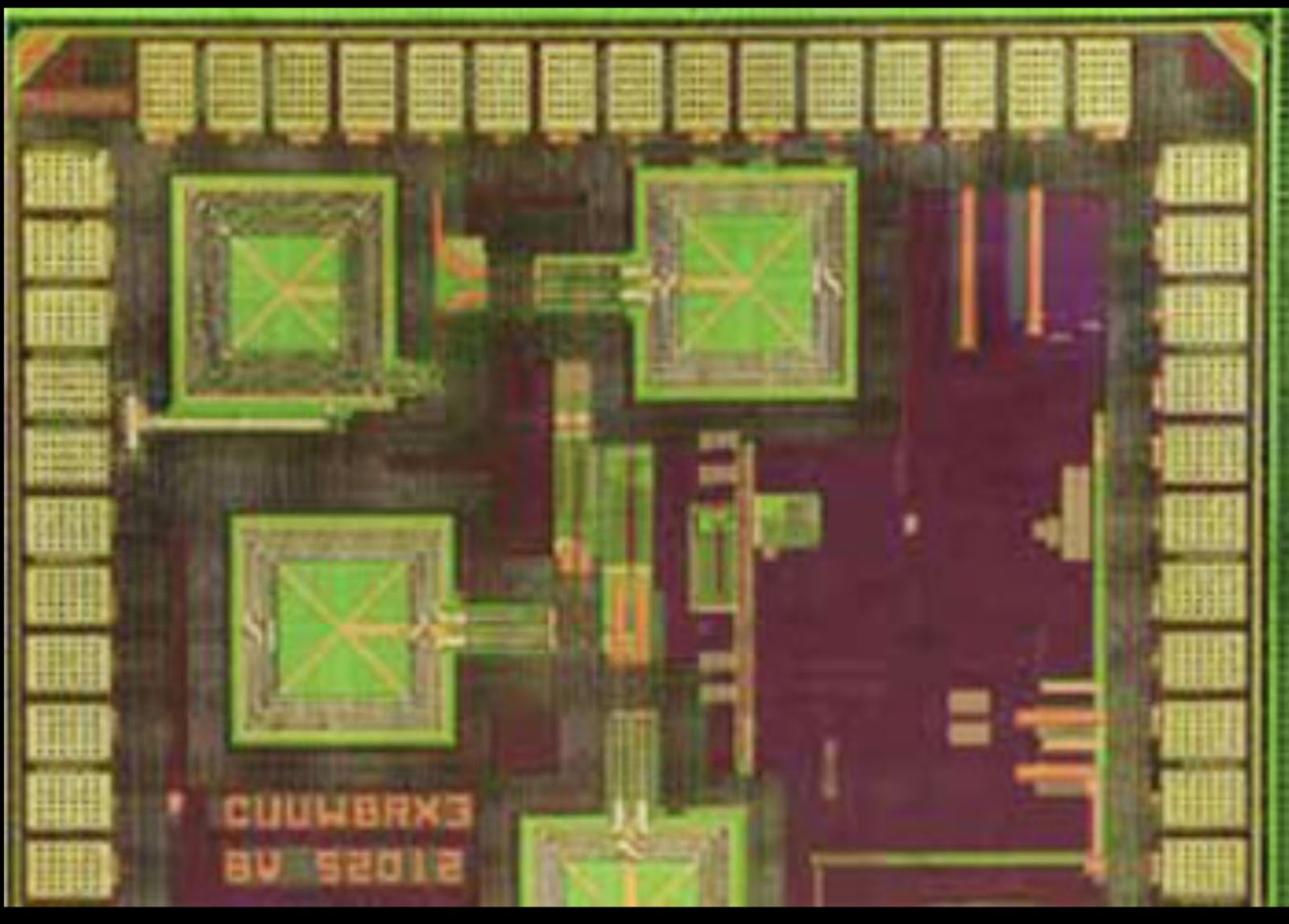
All our mobile devices require regular recharging of their batteries, but what if they didn't have batteries because they were self-powered. Columbia University researchers asked that question, then answered it with a new microchip architecture that uses 100-times less power--small enough to be self-powered from light--indoors or out: R. Colin Johnson @NextGenLog

Columbia University demonstration chip shows that by cutting power 100-times plus communicating only when necessary, ambient light can power battery-free standalone self-powered sensors.
Further Reading

Monday, February 04, 2013

#MEMS "MooMonitor Keeps Cows Happier"

Farm animals represent billions of units for MEMS sensor makers, that is if original equipment manufacturers (OEMs) like Dairymaster can convince farmers to collar all their animals. The MooMonitor, for instance, keeps track of every cow in the herd, letting them into the barn for milking and out to the pasture for grazing through automatic doors keyed to their collars, plus alerts the farmer when a cow needs a bull for the night during ovulation: R. Colin Johnson @NextGenLog

Dairymaster's MooMonitor tracks a herd, monitors each cows activity, letting them in and out of automatic doors and detects when they are ovulating.
Further Reading