ENERGY | WIRELESS | NANOTECH | MEMS | OPTICS | QUANTUM | 3D | CHIPS | ALGORITHMS

Tuesday, August 09, 2011

#ALGORITHMS: "IntraLinks SaaS Community Roadmap Unveiled"


Premiere business-to-business deal- and process-management SaaS maker IntraLinks reveals its roadmap for a transformation into a real-time collaboration network.

Premiere business-to-business deal- and process-management SaaS maker IntraLinks reveals its roadmap for a transformation into a real-time collaboration network. Already an industry leader in secure, cloud-based SaaS (software as a service) tools that more than 1 million business users are accessing to communicate, share documents and manage critical business processes, IntraLinks recently revealed its roadmap for transforming into a real-time collaborative network, complete with community-building toolsets.

"Today, we have over 70 enterprise use cases where we provide secure SaaS solutions for high-value transactions, such as mergers and acquisition deals," said John Landy, chief technology officer at IntraLinks. "But looking forward, we are investing heavily in a roadmap that provides enhanced case-management tools for adaptive workflows, community-building, and structured collaboration you can use online or off."

IntraLinks' community-building efforts permit the user base to interact by maintaining profiles, contact lists and analytics regarding opportunities to participate in upcoming projects.
(Source: IntraLinks)
IntraLinks users access the company’s services either with their Web browser or with the IntraLinks' mobile applications for iPad, iPhone or BlackBerry. Once signed in, users can access templates of best practices that simplify the use of containers to exchange documents relevant to their particular business process. This multi-tenet SaaS solution allows users to search across workspaces to find and exchange documents, no matter where they are stored. Besides its two data centers, IntraLinks maintains two additional SunGuard protected repositories for secure documents, as well as multi-factor protocols and encryption services for users that request the highest level of security.

For the future, IntraLinks has embarked on a year-long transformation process that will be incrementally released over the rest of the year, and which beta-testers are already helping debug.

"Pharmaceutical companies already use us today for their start-up processes when they have a new drug study, making all the documentation available and making sure [participants] have uploaded all the proper forms. Now we want to build additional use cases around that model," Landy said, adding that this is an area where the company plans to make great investments going forward.

The first enhanced SaaS capability will be a new case-management process that IntraLinks calls "guided collaboration," which will provide adaptive workflow monitoring and tracking of due-diligence processes, including approvals, all of which will be managed from convenient dashboards.

The second major enhancement to its offerings will formalize community access for its million-strong user base, allowing individuals to search and find colleagues with whom they have previously worked, or who have skill sets that are relevant to a new project they are starting. The social-networking-style interface will provide both individuals and enterprises with a marketplace-style community, allowing new projects to be offered and skill sets to be hawked using industry-specific tagging schemes.

The third new capability will build on a separate IntraLinks application called the Courier, which is used offline to automate the process of electronically exchanging documents for red-lining and approvals, thus eliminating the need for faxing or courier exchanges of physical documents. The new improved Courier SaaS, now called by its internal code name, "Project Collabrio, " will be integrated with IntraLinks portals to provide real-time collaboration services including Chat.

Further Reading

Monday, August 08, 2011

#MATERIALS: "Rare Earths Getting Rarer"

Intematix has solved the problem with rare earth scarcity by moving its production to China, for now, and developing alternatives to rare earths in its manufacturing plant in the U.S.


The irony about rare earths is that they are not that rare, its just that the only operating mines, right now, at in China. Eventually, the U.S., Canada, Australia and many other sites in Asia and Europe will open but for the next five year price gouging and hoarding are likely to run rampant...

Further Reading

#ALGORITHMS: "XSEDE Cyber-Science to Exceed Teragrid"


The Extreme Science and Engineering Discovery Environment (XSEDE) exceeds its predecessor--the Teragrid project--by linking the most advanced U.S. supercomputers into a cyber-infrastructure provisioned with simplified user-access software enabling researchers to address more diverse projects extraordinaire.

The National Science Foundation has kicked off a successor to its popular Teragrid project, that links together 17 of the nation's fastest supercomputer and software development centers with infrastructure support to realize the world's most advanced applications in materials science, medicine, genomics, astronomy, biology and specialty fields like earthquake engineering.

The new Extreme Science and Engineering Discovery Environment (XSEDE) “will expand on the range of services offered by TeraGrid," said John Towns of the University of Illinois's National Center for Supercomputing Applications. Towns, who had a variety of roles in the TeraGrid project, will lead the XSEDE project. "XSEDE will establish a distributed environment that increases the productivity of researchers with collaborative tools and direct access to instrument data in addition to high-performance computing resources."

The result will be a cyber infrastructure that encompasses resources from XSEDE and other providers, creating a living ecosystem of services that researchers and educators can use to develop capabilities that go beyond the raw supercomputer power provided by the previous TeraGrid program.

XSEDE will create immersive 3D simulations like this one of a blowout similar to that which destroyed the Deepwater Horizon oil rig in the Gulf of Mexico where "ribbons" of color indicate flows. (Source: LSU Center for Computation and Technology)
"XSEDE will put processes in place that evolve the environment over time as new technologies emerge and as new requirements are understood from the user community," said Towns.

The NSF Office of Cyberinfrastructure will coordinate the addition of new disciplinary areas to engage more research areas that were included under the TeraGrid umbrella. The NSF has already allocated $121 million to kick-off XSEDE which will be led by the University of Illinois's National Center for Supercomputing Applications and will link 16 supercomputer sites nationwide at the University of Illinois at Urbana-Champaign, Carnegie Mellon University/University of Pittsburgh, University of Texas at Austin, University of Tennessee, University of Virginia, Southeastern Universities Research Association, University of Chicago, University of California San Diego, Indiana University, Jülich Supercomputing Centre, Purdue University, Cornell University, Ohio State University, University of California Berkeley, Rice University, and the National Center for Atmospheric Research.

The Shodor Education Foundation will also participate, helping to develop new software tools that propel scientific discovery. A simplified User Access Layer--managing authentication and job monitoring--will be developed to enable applications to be run on its resources without the detailed knowledge that was typically necessary to make optimal use of previous TeraGrid resources.

More than 10,000 scientists used the TeraGrid supercomputer resources over its 10-year lifetime--2001 to 2011--all at no cost. XSEDE will likewise provide integrated supercomputer, networking, and software infrastructure resources to needy scientists and engineers nationwide, but will broaden its application base to include new kinds of community-based projects.

Further Reading

Friday, August 05, 2011

#CHIPS: "Authentication Chips Combat Rampant Counterfeiting"


Counterfeiting has spread from credit cards to microchips to circuit boards and entire networking appliances, prompting semiconductor makers worldwide to pioneer a new billion dollar market for smart authentication microchips.

Smart cards have pioneered in the anti-counterfeiting market by perfecting authentication microchips, which ensure that credit and security cards are genuine and authorized. Now major microchip makers are diversifying into authentication chips for a variety of markets rife with counterfeiting. The chips can be used in everything from computer circuit boards to networking devices that connect to cloud computers.

"Counterfeiters are cloning a range of electronic components, prompting networking companies like Cisco to start using authentication chips in their devices," said John Devlin, senior practice director for AutoID and smart cards at ABI Research (Scottsdale, Ariz.). "The market is small now--only around $100 million--but will grow to over $4 billion by 2016."


The authentication microchip market is small today, but will grow rapidly in a diverse anti-counterfeiting market expected to be worth $6 billion by 2016.
Authentication chips cast into hardware the identity-based cryptography protocols that exchange secure keys to guarantee that the manufacturer who claims to have made a device is genuine. Encryption is usually also employed to prevent the kind of eavesdropping on the secure key exchange that counterfeiters can use to fake identity-based protocols. The exact algorithms used are often kept a closely guarded trade secret by the authentication microchip manufacturers, which include the makers of smartcard microchips, such as NXP, STMicroelectronics, Infineon, Inside Secure, Maxim and Renesas.

Today, microchip-based security solutions amount to just five percent of the total anti-counterfeiting, brand protection and authentication market, but it is one of the most profitable segments accounting for as much as 32 percent of total revenue, according to ABI Research. And going forward, the firm predicts that authentication microchips will be the fastest-growing segment of the market for the next five years.
Counterfeit components are being found in nearly every category of device, according to Devlin, who claims that even President Obama's Air Force One aircraft has detected and replaced counterfeit components, prompting the Federal Aeronautics Administration to introduce special training procedures to spot counterfeits. The National Electronics Distributors Association estimates that in 2010 the IT industry alone lost $100 billion to counterfeit components.

Secure memory chips have been used for several years in many anti-counterfeiting applications, according to Devlin, but authentication microchips have only been widely available for about a year and a half, permitting almost any type of electronic device to employ smart algorithms that guarantee that they are genuine.

Authentication microchips typically add less than a dollar to the cost of manufacturing an electronic device and are usually mounted on printed-circuit boards alongside other components. Prices are dropping too, which will permit even cost-sensitive devices like radio-frequency identification tags to include authentication protocols in the near future, according to Devlin.

Further Reading

Tuesday, August 02, 2011

#CHIPS: "Freescale processors gain on-chip e-reader"


Earlier this year, Freescale Semiconductor Inc. announced the first line of processors designed to power sub-$99 e-readers. Now it has extended that line downward with integrated E-Ink driver circuitry for low-end devices from medical and home/office automation to watches whose face is an electronic paper display (EPD).
Further Reading

#ALGORITHMS: "Top Trader Bot Beats All Humans"


Human traders don't have a chance against bots which have been competing among themselves for a decade, resulting in a super-bot whose adaptive aggression annihilates all animates. A decade has passed since IBM's seminal demonstration that software bots could beat humans at securities and commodities trading. Since then the bots have been competing among themselves until now, on the 10-year anniversary of bot's supremacy, an architecture called AA (adaptive-aggressive) has emerged as king-of-the-hill.

The International Joint Conference on Artificial Intelligence (IJCAI), held last month in Barcelona, marked a decade since its 2001 meeting where software robots (bots) proved their supremacy over humans at stock-market trading. Technically called a continuous double auction--since both buyers and sellers set prices on their offers--CDA today dominates the trading activity on nearly all commodity and stock exchanges. Most institutional investors use bots that are variations on the well-known CDA strategies which were outlined a decade ago in an IBM paper at IJCAI 2001 entitled: Agent-Human Interactions in the Continuous Double Auction.

In that paper, software bots were shown to consistently outperform human traders on real-time CDA markets, in particular by using two trading-agent strategies called ZIP (zero-intelligence plus) and GD (after the economists Steven Gjerstad and John Dickhaut). In subsequent work, the same research group at Thomas J. Watson Research Center reported an improved strategy they called GDX, which outperformed both ZIP and GD when bots were pitted against other bots (as is the case today on most modern stock and commodities exchanges).

The performance of IBM's GDX continues to be used as a figure-of-merit for commercial bidding strategies, but according to a new paper presented this year at IJCAI 2011, a newer strategy called Adaptive Aggressive (AA) outperforms ZIP, GD and GDX in bot-versus-bot trading. The new paper entitled: Human-Agent Auction Interactions: Adaptive-Aggressive Agents Dominate was presented last month at the conference by professor Dave Cliff and doctoral candidate Marco De Luca, both of the University of Bristol (England).

The AA algorithm differs for the other algorithms in that it aggressively trades off profit for the ability to make a transaction, it then adapts its aggressiveness after each completed buy or sell. By mimicking the method used in IBM's original paper to judge the bots, Cliff and De Luca claim to show that AA outperforms all the other strategies in both bot-to-bot and human-versus-bot trading.

Further Reading

Monday, August 01, 2011

#MATERIALS: "Wet Electronics Open Door to New Possibilities"


Gadgets, gizmos and wireless wonders must be fastidiously protected from moisture today, but researchers using circuitry with the consistency of Jell-O claim that the smarter electronics of the future will be all wet. Twice I ran my old Sony-Ericsson cell phone through the washing machine and it miraculously survived, but that is only a testimonial to device's excellent waterproofing technologies. That all may change soon, when ultra-secure moisture-friendly prototypes recently shown by North Carolina State University (NCSU) are commercialized.

Today, electronic devices of all types must be protected from not only submersion in water, but even from humidity in the air. Medical implants, for instance, must be hermetically sealed to secure them from shorting out. By harnessing the synergy between water-compatible hydrogels and liquid metals, NCSU researchers herald a new era of smarter moisture-compatible electronic devices.
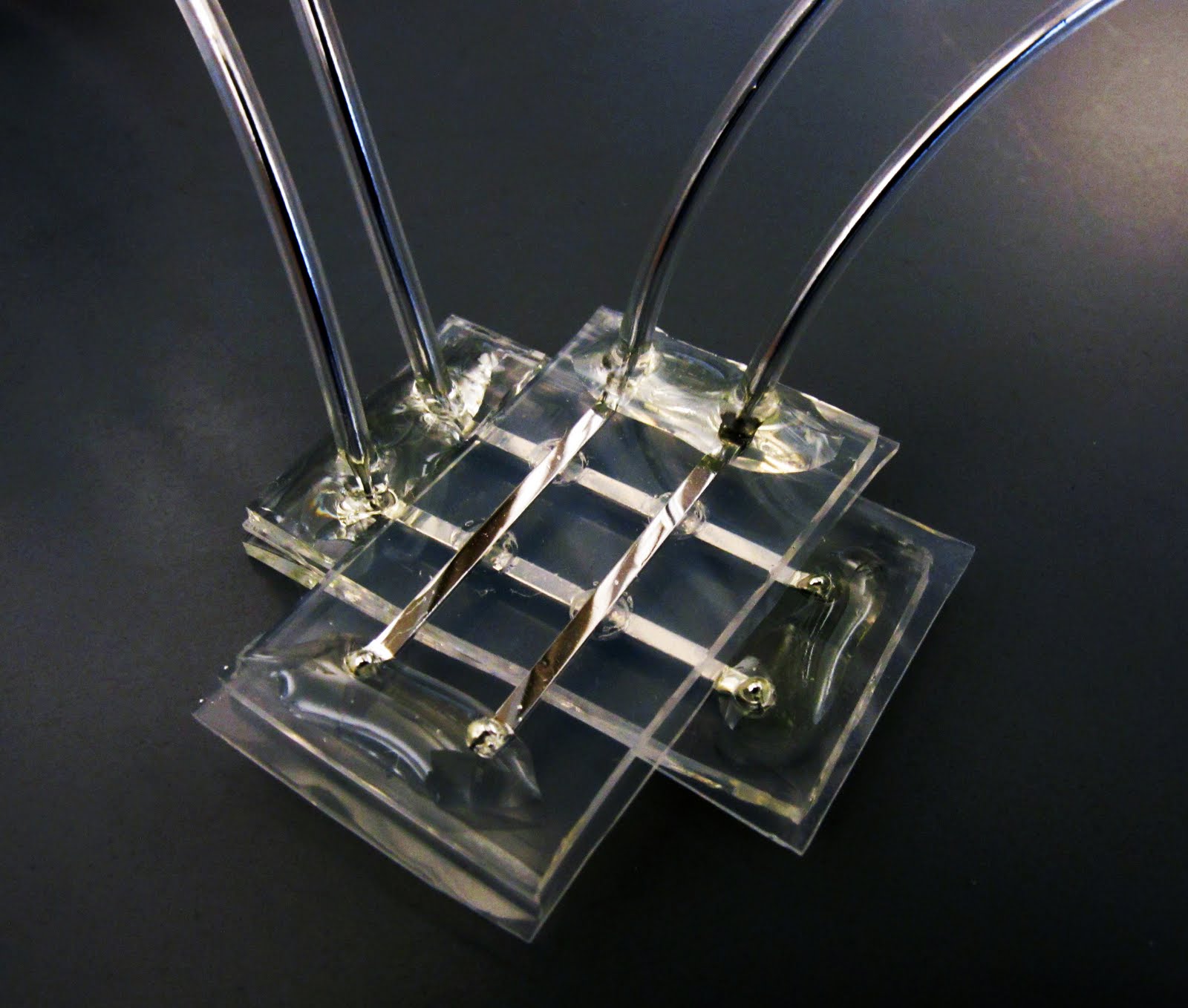
A 2-by-2 array of crossbar switches where memory-resistors at each crossing operate like synapses in the brain. (Source: NCSU)

As you might imagine, materials that can happily be submerged without dissolving or shorting out their circuitry are few and far between. And those that can—such as plastics—have inferior electrical characteristics, making them too slow reacting for medical implants and other mission-critical electronics that must work rain or shine. However, by combining liquid metals with polyelectrolyte hydrogels, which have the consistency of Jell-O, a new class of fast submersible gadgets is on the horizon.

The key to this invention of NCSU professor Michael Dickey, however, is not the water compatibility of the materials themselves, but rather the ability of the metal—an eutectic alloy of gallium and indium—to form a nonconductive oxide skin when current flows through it. The switches can be programmed to act like synapses in the brain. In effect, these crossbar switches remember their "experiences"—an effect called a memory-resistor, or memristor, by their inventor, University of California at Berkeley professor Leon Chua (this technology is currently being commercialized by HP Labs and Hynix).

Consequently, the new liquid-metal/hydrogel combination can be used to create brainlike circuitry that learns from its environment. The first task of these new water-compatible circuits, however, will be much less ambitious, since for one thing they are still being built on the millimeter scale rather than the micron- and nano-scale of circuitry in the brain. However, simple circuitry can be realized with the new approach to create biological sensors that can be directly implanted for medical monitoring.

NCSU doctoral candidates Hyung-Jun Koo and Ju-Hee So also contributed to the work, which was funded by the National Science Foundation and the U.S. Department of Energy.

Further Reading

#NANOTECH: "Nanocircuits that adhere to any substrate"


Researchers at Stanford University recently demonstrated a novel wafer-scale lift-off process for fabricating nanowire-based circuits on reusable silicon wafers, then transferring them to any substrate in any shape. The research team, led by professor Xiaolin Zheng, claims the flexible circuitry can be used to create anything from paper-thin displays and solar cells to biomedical sensors that attach directly to the tissue being monitored.
Further Reading